Challenge
For a long time, employee leave was managed in a single shared file. For a small team, this approach was sufficient: HR kept the information up to date, employees contacted HR to check their remaining balances, and leave requests and approvals were handled through regular communication.
As the company grew, the process became more complex. The number of employees increased, different countries and holiday calendars had to be taken into account, and individual conditions, carryover balances, additional days based on length of service, and specific calculations for employees joining in the middle of the year all became part of the process.
These rules could still be managed manually, but doing so required more and more time and attention from HR. At the same time, there was a growing need to give employees direct access to their current balances, allow them to submit requests independently, and track their status in one place.
Another important challenge was migrating existing data to the new system. Several years of leave history and individual employee balances had already accumulated, so starting from scratch was not an option. The new system had to preserve the existing records and provide accurate balances from the first day, consistent with the data maintained by HR.
Solution
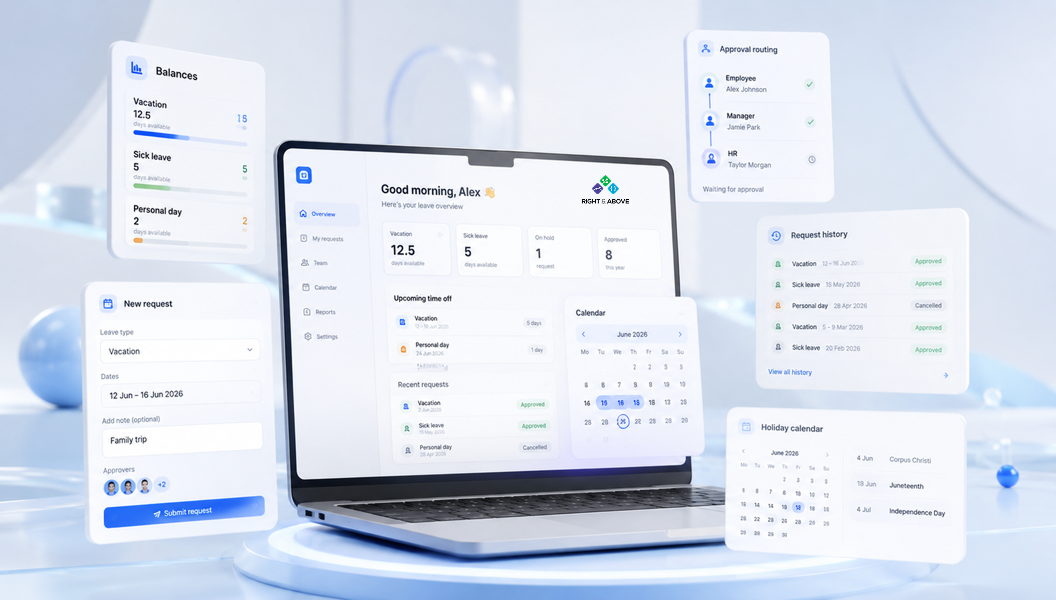
A centralized system was created to manage leave calculations, requests, approvals, and historical records.
Each employee’s balance is calculated based on accrued days, leave already used, and carried-over balances. Leave days accrue gradually according to the applicable rules, while all changes are recorded in the history. This makes it possible to verify the current balance and understand how it was calculated.
The main leave calculation rules were also incorporated into the system. It accounts for employees joining partway through the year, additional leave based on length of service, carryover limits, and different national holiday calendars. Common rules can be applied to groups of employees without configuring every profile individually.
Employees can independently view their available balance, accrued and carried-over days, leave already used, and planned periods of absence.
When future leave is planned, the system also takes into account the days that will accrue by the selected date. For example, an employee can submit a request for the end of the year in advance, while the available balance is calculated specifically for the planned leave period. If there are not enough paid leave days available, this becomes clear before the request reaches the approval stage.
The system supports not only full-day leave but also absences of several hours, allowing shorter periods to be recorded without using an entire working day.
Requests are routed to designated approvers, while their current status and full history remain available in the system. Approval can also be disabled for specific scenarios. Administrative adjustments are recorded together with the reason for the change.
Employees sign in using their existing corporate accounts. Employee information and access permissions are synchronized with the corporate directory, so there is no need to create and maintain separate accounts.
Historical data was migrated while preserving the sequence of past events. The system processed the records chronologically, applying the relevant accrual and leave usage rules, and the resulting balances were then verified against HR data.
The system also maintains an audit history of actions and sends notifications about changes and decisions related to leave requests.
Result
As a result, the company received a single leave management process instead of several disconnected actions and sources of information.
Employees can independently check their balances, plan leave in advance, submit requests, and track their status. Approvers work with requests directly in the system, while HR can manage rules and exceptions without continuously maintaining calculations manually.
At the same time, the leave history accumulated over previous years was preserved. Accruals, used days, carryovers, and adjustments are now stored in one place and can be reviewed whenever necessary, while the transition to the new system did not require the company to restart leave accounting from scratch.