Artificial intelligence is no longer seen as a single intelligent assistant.
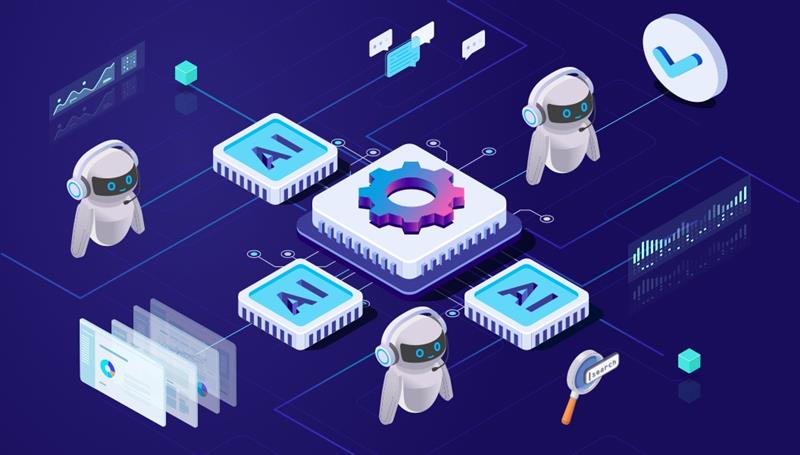
More and more companies are shifting toward AI Multi-Agent Systems – architectures where tasks are handled by a team of specialized agents, each responsible for a specific part of a larger process.
This is not just another fashionable concept. It is rapidly becoming a new standard for mature engineering organizations.
This approach does not simply replace a human in one step of the process. It redefines the entire architecture of automation. Multi-agent systems are not about chatbots you call on demand. They represent the emergence of digital departments within the enterprise: an analyst agent, a critic agent, an executor agent, and a documentation agent. Together, they form a new type of distributed intelligence, capable of acting autonomously, thinking critically, preserving knowledge, and, most importantly, explaining its reasoning.
What is a Multi-Agent System? Explained in Simple Terms
At the core of any multi-agent system lies a simple idea: instead of forcing one universal AI to solve everything, we distribute responsibility across several focused agents. Think of it like a real-world team: one person handles research, another validates results, a third makes decisions, and a fourth documents outcomes.
Each agent is capable of:
- Accepting goals and decomposing them into step-by-step actions,
- Interacting with other agents via APIs or shared memory,
- Using and preserving context to maintain logical consistency,
- Questioning or validating each other’s outputs (through dedicated critics),
- Building transparent chain-of-thought reasoning to explain their decisions.
Crucially, these agents are not simply executing instructions. Each one can make decisions in its own domain, rely on long-term or short-term memory, and estimate the confidence level of its results. This enables coordination without the need for constant human supervision.
Multi-Agent Architecture in Practice
We started exploring this architecture when the number of internal systems, integrations, and knowledge sources began to overwhelm traditional pipelines. Manual work was no longer sustainable, and rigid workflows collapsed under their own complexity.
The multi-agent approach enables the development of scalable, flexible solutions without compromising control.
RAG Agents: Assistants That Know Everything
Our first multi-agent deployment was within the knowledge and documentation domain. We built a team of RAG agents (Retrieval-Augmented Generation) to serve as internal knowledge assistants.
These agents:
- Index internal sources such as GitLab,
- Retrieve relevant context based on natural-language queries,
- Generate write-ups, documentation, and summaries,
- Validate factual accuracy through critic agents,
- Flag outdated documents and suggest automated rewrites.
This system freed our engineers from dozens of hours of routine documentation tasks.
Instead of digging through old release notes or searching for outdated architecture pages, they can simply ask a question and receive a structured, validated answer generated on the fly.
DevOps Agents: Monitor, Predict, and Remediate
The next step was applying the same principles to operations and infrastructure.
Our DevOps agents learned from patterns in metrics, logs, and incident history.
They now help us with:
- Monitoring infrastructure,
- Detecting anomalies and predicting outages,
- Proposing remediation strategies,
- Generating risk documentation and architecture suggestions.
Instead of just alerting a human, these agents provide actionable reports with explanations and recommendations – just like having a senior DevOps engineer available 24/7.
Engineering Assistants: Automating Everything from Code to MRs
We also built agents that integrate with GitLab and our CI/CD pipelines.
These assistants:
- Review merge requests and flag architectural inconsistencies,
- Compare approaches across modules and suggest alignment,
- Auto-generate changelogs,
- Write documentation based on diffs and commit history,
- Ensure compliance with coding standards and team conventions.
This reduced the burden on tech leads and senior developers, letting them focus on strategic decisions instead of repetitive reviews.
But There Are Trade-Offs
Despite their clear benefits, multi-agent systems come with real challenges. The more you understand these early on, the better your implementation will scale.
- Increased Complexity and the Need for Architecture
Every interaction between agents needs to be designed:
Who initiates? Who validates? Where is memory stored? What happens if agents disagree?
Without a strong architectural foundation, complexity spirals out of control.
- The Cost of Deep Reasoning
Chain-of-thought logic, memory layers, and agent-to-agent communication require tokens, API calls, and time.
Without proper controls, the system becomes slow and expensive.
You need a smart orchestrator that strikes a balance between reasoning depth and responsiveness.
- Debugging and Auditing Become Difficult
With a single LLM, debugging is easy – you see a prompt and a response.
With five interacting agents, each with its own memory and reasoning chain, debugging becomes a forensic task.
You need tools to trace the reasoning path and visualize each agent’s behavior.
- Trust Management Is Crucial
Autonomous agents may make unexpected decisions, especially when interacting in complex chains.
It is critical to define:
- Guardrails (hard limits on what agents can do),
- Validation checkpoints that escalate to humans,
- Role-based access control and scope restrictions.
- Security and Privacy Concerns
When agents interact with sensitive data, DevOps pipelines, or customer environments, the attack surface increases.
We address this by:
- Running local LLMs (like Ollama) within a secure perimeter,
- Encrypting all memory and internal communication,
- Sandboxing agent actions,
- Blocking all external API calls unless explicitly allowed and validated.
- Not Everything Needs to Be a Large Language Model
Sometimes, a small fine-tuned model or even a rule-based script will be more effective.
Do not force every task into a universal foundation model if a simpler tool can accomplish the job more effectively.
Conclusion
Multi-Agent Systems are not just another turn of the AI hype cycle.
They represent a fundamental shift in how enterprises think about automation, workflows, knowledge management, and decision-making.
Companies that start building internal AI teams today – teams made of collaborating, self-checking, memory-enabled agents – will gain a lasting competitive advantage in speed, scale, and accuracy.
The question is no longer “Should we use AI?”
It is “How quickly can we turn our workflows into a coordinated system of reliable, auditable AI agents?”